
ALCATRAZ HISTORY
Alcatraz Island history
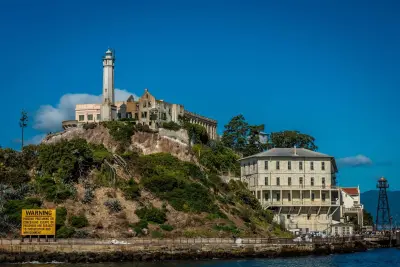
Alcatraz Island, located near San Francisco, California, was developed in the mid-19th century with a lighthouse, a military fort, and a military prison. In 1934, it became a federal prison, known for being nearly impossible to escape due to the cold waters and strong currents surrounding the island. The prison closed in 1963 and is now a popular tourist attraction managed by the National Park Service.

How the island got its name
The first European to document the islands of San Francisco Bay was Spanish naval officer Juan Manuel de Ayala in 1775 during the Spanish rule in California. He mapped the bay and named today’s Yerba Buena Island La Isla de los Alcatraces, meaning “The Island of the Pelicans”. In old Spanish, ‘alcatraz’ referred to pelicans. On Ayala’s chart, Yerba Buena Island was labeled Isla de los Alcatraces.
Later, English naval officer Captain Frederick W. Beechey applied the name to the rock now known as Alcatraz Island.
Over time, the name Alcatraz became widely used. In 1827, French Captain Auguste Bernard Duhaut-Cilly described passing the island, noting it was covered with pelicans that rose in a massive cloud when disturbed. The California brown pelican no longer nests there, though.

The first owner
The first recorded owner of Alcatraz was Julian Workman. According to the earliest documents, Mexican governor Pio Pico granted Alcatraz Island to Julian Workman in 1846 to build a lighthouse there. Later that year, John C. Frémont purchased the island for $5,000 on behalf of the U.S. Government.
However, after California became part of the United States, President Millard Fillmore designated Alcatraz for military use. The sale was invalidated, leaving Frémont without compensation. Frémont and his heirs pursued lengthy legal battles for compensation, but their efforts were unsuccessful, with the disputes continuing into the 1890s.

Fort Alcatraz
After the U.S. took control of California in 1848 through the Treaty of Guadalupe Hidalgo and the Gold Rush began the following year, the Army planned to use Alcatraz Island to defend San Francisco Bay. The building of Fort Alcatraz started in 1853 and lasted five years. Once completed, the fort housed 200 soldiers.
During the Civil War (1861-1865), Alcatraz was armed with 85 cannons (in the 1860s increased to 111) to protect the bay. However, only a few could be used at a time, and none of the cannons were ever used in battle. The fort also stored weapons to keep them out of the hands of Confederate sympathizers and prisoners of war. Alcatraz was part of a planned defense system with Fort Point, though some parts, like Lime Point, were never built. The island also had the first lighthouse on the West Coast. In 2019, archaeologists used radar to explore the ground beneath the former prison yard. They discovered well-preserved tunnels, storage rooms, ammunition magazines, and other structures from Alcatraz’s military past.

Transition to military prison
In the 1860s, Alcatraz transitioned from a coastal defense fort to a military prison. Its remote location and San Francisco Bay’s cold, powerful water currents made it an ideal site for securely holding prisoners. A brick jailhouse was built in 1867, and the island officially became a long-term detention facility the following year. In 1898, due to the Spanish-American War, the prison population rose to over 450. Alcatraz housed various prisoners, including Civil War POWs and Native Americans.
Construction of the main concrete cell block began in 1909 and was completed in 1912, becoming the island’s most recognizable structure. During World War I, the prison held people who refused to fight, known as conscientious objectors. By 1933, the military prison building was closed and handed over to the Bureau of Prisons, preparing Alcatraz to become the infamous federal penitentiary it is known as today.

Alcatraz Federal Prison
The U.S. Department of Justice took control of Alcatraz on October 12, 1933, and turned it into a federal prison in August 1934. Its primary purpose was to house prisoners causing trouble in other federal prisons. The first group of 137 prisoners arrived on the island on August 11, 1934, from Kansas, escorted by 60 guards, FBI agents, and U.S. Marshals.
During its 29 years of operation, Alcatraz housed some of America’s most notorious inmates, mainly bank robbers and murderers. The prisoners included dangerous criminals like Al Capone, Robert “Birdman of Alcatraz” Stroud, George “Machine Gun” Kelly, and others. The prison initially had 155 members of staff who were mainly trained in security rather than rehabilitation.
Discover the island’s secrets on our exclusive Alcatraz tours!

Ferry ride included
Alcatraz Day Tour
Visit Alcatraz Island at your own pace and learn about its history with an audio guide. Explore the cell blocks and learn about Al Capone, "Machine Gun" Kelly, and other infamous prisoners, as well as why escape from the island was hard. The tour includes a convenient round-trip ferry ticket.

Private experience
Alcatraz Night Tour
Discover Alcatraz after sunset on a self-guided tour and listen to stories from an audio guide. Catch a glimpse of the illuminated Golden Gate Bridge. You can stay for as long as you'd like, so you can walk at your own pace. The ticket includes ferry rides to the island and back.

Escape attempts
Although escape seemed impossible, during its 29 years of operation, 36 prisoners made 14 escape attempts. Most were caught or killed, with only a few unaccounted for. Of those who attempted to escape, 23 were captured alive, six were shot and killed, two drowned, and five remain “missing and presumed drowned”. The most violent event occurred on May 2, 1946, when a failed escape by six inmates led to the infamous Battle of Alcatraz.
Another famous escape incident occurred in 1962 when Frank Morris and brothers John and Clarence Anglin broke out. Although they were never found and are believed to have drowned, their fate remains a mystery, leading to speculation about their fate. Despite its reputation, escape from Alcatraz was not impossible. In 1962, John Paul Scott swam to shore but was found unconscious and suffering from hypothermia. Today, the Escape from Alcatraz Triathlon includes a 1.5-mile swim from the island to the bay shore.

Closing of the prison
On March 21, 1963, Alcatraz prison, often called “The Rock”, officially closed. There were several reasons leading to the decision. Its operating costs were much higher than those of other prisons, averaging nearly $10 per prisoner per day compared to $3 at the Atlanta facility. Also, years of exposure to salt water had badly damaged the buildings, and the escape incident in 1962 further contributed to the decision.
Native American Occupation of Alcatraz
The Native American occupation of Alcatraz began with a small protest in 1964, led by Lakota Sioux activist Belva Cottier and her cousin Richard McKenzie. A larger occupation followed on November 20, 1969, when the United Indians of All Tribes, mostly college students from San Francisco, took over the island. They demanded Alcatraz be turned into a cultural, educational, and ecological center for Native Americans, citing the Treaty of Fort Laramie (1868) and the Right of Discovery. They claimed the island by the Right of Discovery, arguing that indigenous people had known about Alcatraz for thousands of years before Europeans arrived in North America.
The protest lasted 19 months, attracting nationwide support, including members of the American Indian Movement (AIM). Several buildings were damaged or destroyed, and graffiti from the occupation remains visible. The event raised awareness about Native American rights, prompting President Nixon to end termination policies and support tribal self-determination. The occupation ended on June 11, 1971.

From prison to park
In 1972, the National Park Service acquired Alcatraz Island to establish the Golden Gate National Recreation Area. Under the “Act to Establish the Golden Gate National Recreation Area”, President Richard Nixon approved $120 million for land acquisition and development. Alcatraz was added to the National Register of Historic Places in 1976 and received the highest recognition as a National Historic Landmark in 1986.
The National Park Service approved the Alcatraz Development Concept and Environmental Assessment plan, doubling the areas open to the public to present its scenery, wildlife, and marine life. Since then, Alcatraz has been managed as part of the recreation area and operates as a popular tourist attraction and museum, focusing on its history as a federal prison.

Alcatraz across media & art
Alcatraz Island has been a popular setting in films, TV shows, books, and video games. It has appeared in numerous movies, like Escape from Alcatraz (1979), The Rock (1996), Catch me if you can (2002), The Book of Eli (2010), and the TV series Alcatraz (2012).
It’s a prominent location in video games like Tony Hawk’s Pro Skater 4, Call of Duty (Mob of the Dead, Blood of the Dead), The Escapists, and Watch Dogs 2.
Books such as “Al Capone Does My Shirts” and “The Battle of the Labyrinth” also feature the island, and the rock band Scorpions filmed their music video “No One Like You” on the island. Alcatraz has hosted several art installations exploring themes like human rights. Often portrayed as a prison and a secret base, Alcatraz remains a widely organized and popular setting in media and entertainment.
Alcatraz Today
Today, Alcatraz is a popular tourist attraction due to its rich history as a military fort and notorious federal prison. Visitors are drawn to its dramatic escape stories, infamous inmates like A. Capone, and the chance to explore its historic cell blocks and unique location in San Francisco Bay.
Want to explore more of San Francisco?

Private or small group
Alcatraz Helicopter Tour
See Alcatraz Island and other top landmarks in San Francisco on an exciting helicopter ride! Get a unique photo of the Golden Gate Bridge, referred to as the most photographed bridge in the world. You can also see Ocean Beach, Oracle Park, Downtown San Francisco, and more. Learn about the city's history from the pilot and the helpful audio guide, and choose a private or small group tour for maximum enjoyment!

30+ attractions
San Francisco City Pass
Enjoy access to more than 30 attractions in San Francisco! See Alcatraz on a cruise, visit the San Francisco Zoo, the Aquarium of the Bay, the San Francisco Museum of Modern Art, the Walt Disney Family Museum, see the city on a hop-on hop-off bus tour, and more. Your pass includes a digital guide and is valid for 1-5 days, so you can have fun at your own pace.